Part 1 — The Woman Who Never Complained
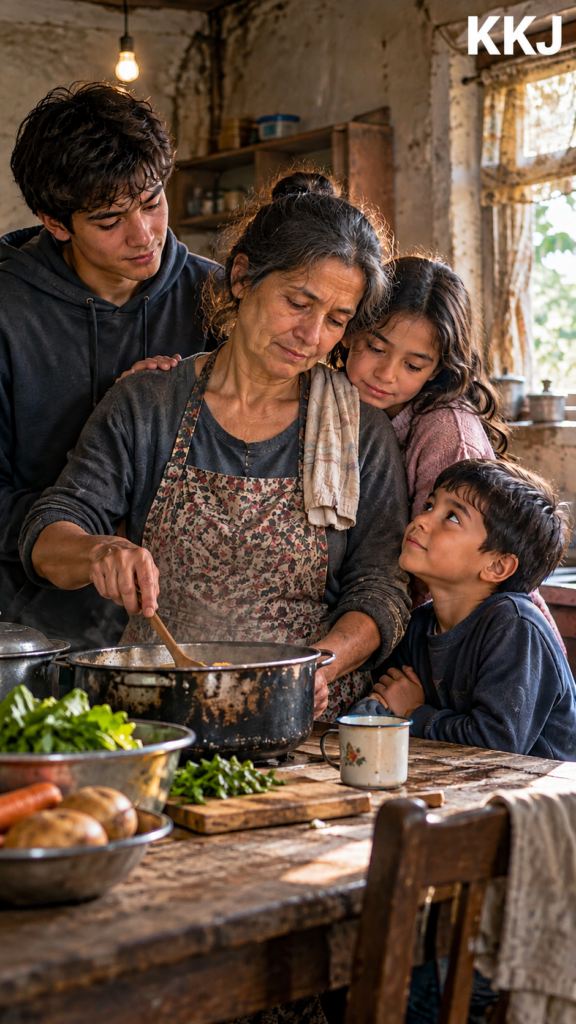
Every evening, when the sun disappeared behind the hills, Maria stood in the tiny kitchen of her old house and stirred the same blackened cooking pot.
There was nothing special about the meal.
A few potatoes.
Some vegetables.
A little rice.
Sometimes, if she had enough money, there was an egg to divide between the four of them.
But Maria always smiled as though she were preparing a feast.
Her three children watched her from around the worn wooden table.
Daniel, seventeen, sat quietly with his elbows resting on the table. He was tall and thin, with tired eyes that made him look older than his years.
Beside him sat Lily, twelve, holding a small bowl in both hands.
And on the other side was little Samuel, eight, swinging his legs beneath the chair.
Their father had been gone for years.
Not dead.
Not missing.
Just gone.
He had walked away when Samuel was still a baby, leaving Maria with three children, a pile of unpaid bills, and a house that seemed to grow colder every winter.
At first, Maria had believed he would come back.
She waited for phone calls.
She waited for letters.
She waited for footsteps outside the door.
Eventually, she stopped waiting.
She learned that sometimes a person could disappear while still being alive.
And sometimes, the hardest part wasn’t losing someone.
It was explaining their absence to children who kept asking when they were coming home.
“Mom,” Samuel asked one evening, looking into the pot, “is there enough for everyone?”
Maria looked at him and smiled.
“Of course.”
Daniel immediately knew she was lying.
There wasn’t enough.
There hadn’t been enough for weeks.
But Maria had become an expert at making very little look like plenty.
She placed the food into four bowls.
She gave Daniel the largest portion.
Then Lily.
Then Samuel.
Finally, she sat down with the smallest bowl.
Daniel stared at it.
“Mom.”
“Yes?”
“You didn’t give yourself enough.”
Maria smiled.
“I ate while I was cooking.”
Daniel lowered his eyes.
He knew she hadn’t.
He had watched her all afternoon.
She had eaten nothing.
“I’m not hungry,” she added.
Daniel pushed part of his food toward her.
“Take mine.”
“No.”
“Mom.”
“Eat.”
“But—”
“Daniel.”
Her voice was gentle, but firm.
He stopped arguing.
Maria reached across the table and touched his hand.
“You need your strength.”
“For what?”
She smiled.
“For becoming the man I know you can become.”
Daniel looked away.
He didn’t want her to see his eyes filling with tears.
He was seventeen, and he had already started thinking about dropping out of school.
Not because he hated school.
Because he had seen the unpaid electricity bill.
He had seen the empty kitchen shelves.
He had seen his mother’s shoes wearing thin at the soles.
And he knew that something had to change.
After dinner, Daniel quietly washed the dishes.
Lily swept the floor.
Samuel collected the empty bowls.
Maria watched them from the doorway.
For a moment, she felt something warm inside her.
They didn’t have much.
But they had each other.
That was the one thing poverty had never been able to take away.
Later that night, when the children were asleep, Maria sat alone at the kitchen table.
The house was silent.
She opened an old envelope.
Inside was a photograph.
It showed her years earlier, when she was young.
She was smiling beside her husband.
Daniel was still a baby.
Lily wasn’t born yet.
Maria stared at the photograph for a long time.
Then she turned it face down.
She had learned not to live in photographs.
She had three children sleeping in the next room.
They were her future.
She didn’t need the past anymore.
The next morning, Maria woke before sunrise.
She prepared breakfast, packed the children’s lunches, and walked nearly two miles to the bus stop.
Then she went to work cleaning houses.
Her hands were always sore.
Her back always hurt.
But she never complained.
When one employer offered her extra work, she accepted immediately.
When another asked her to work on Sunday, she said yes.
She came home exhausted every evening.
Yet somehow, when the children opened the door, she found enough energy to smile.
“Mom’s home!”
Samuel would run toward her.
Lily would take her bag.
Daniel would quietly look at her face to see how tired she was.
One Friday afternoon, Daniel found her sitting on the edge of her bed.
She was holding an envelope.
“What is that?” he asked.
Maria quickly folded it.
“Nothing.”
“Mom.”
She sighed.
“It is a bill.”
“How much?”
“Don’t worry about it.”
“How much?”
She didn’t answer.
Daniel took the envelope.
His face changed.
The electricity company had given them three days.
If they didn’t pay, the electricity would be disconnected.
“How are we going to pay this?”
Maria looked down.
“I’ll figure it out.”
“You always say that.”
“And I always do.”
“But you shouldn’t have to do everything alone.”
Maria looked at him.
For the first time, she saw the little boy she had once carried in her arms becoming a young man.
“You’re my son,” she said softly. “You’re not supposed to carry my problems.”
Daniel’s voice broke.
“But I’m your son. I should help.”
Maria pulled him into her arms.
For several seconds, neither of them spoke.
“I don’t want you to give up your dreams because of me,” she whispered.
Daniel closed his eyes.
“I don’t have a dream anymore.”
Maria pulled away.
“Yes, you do.”
“What?”
“To make sure your family never has to live like this again.”
Daniel looked at her.
“And what about you?”
Maria smiled sadly.
“My dream is you.”
That night, Daniel couldn’t sleep.
He stared at the ceiling while rain tapped against the old window.
He finally understood something.
His mother wasn’t weak.
She was carrying the weight of four people on shoulders that were already exhausted.
And she had never once asked them to feel sorry for her.
The following week, Daniel found a job at a small mechanic shop after school.
He didn’t tell Maria immediately.
He knew she would object.
But the money he earned was enough to buy groceries.
The first evening he came home with a small bag of rice and vegetables, Maria stared at him.
“Where did you get these?”
“I worked.”
She became silent.
“Daniel…”
“I can do it after school.”
“No.”
“Mom—”
“No. You’re going to school.”
“We need money.”
“I’ll manage.”
“You’ve been managing for seventeen years.”
Maria froze.
Daniel immediately regretted his words.
But then he stepped closer.
“I don’t want you to do this alone anymore.”
Maria’s eyes filled with tears.
She turned away so he wouldn’t see.
But Daniel did.
He walked behind her and hugged her.
Lily and Samuel watched from the doorway.
Lily quietly wiped her eyes.
Samuel didn’t understand everything.
But he understood enough.
He walked over and hugged both of them.
Soon, all four were standing together in the tiny kitchen.
Their clothes were old.
Their furniture was worn.
Their walls needed repair.
Their cupboards were nearly empty.
But for the first time in years, Maria didn’t feel alone.
She looked at her children and whispered:
“Whatever happens, we stay together.”
None of them knew how important those words would become.
Because the next morning, someone knocked on their door.
And when Maria opened it, she saw a face she had not seen in nearly fifteen years.
Her husband’s face.
He stood outside holding a suitcase.
And beside him was a young woman.
Maria’s heart stopped.
The man looked at her and said:
“Maria, we need to talk.”
Behind her, Daniel had already stepped into the hallway.
He saw his father.
And for the first time in his life, he understood why his mother had cried alone at night.
The man looked at his three children.
Then he said something that would change their lives forever.
“I’ve come back to take my children.”